Building a Healthier Future: The Role of Comprehensive Reproductive Health Education for Teens
Comprehensive reproductive health education plays a vital role in equipping adolescents with the knowledge and skills necessary to make informed decisions. This educational approach not only delays sexual initiation and increases contraception use but radically decreases risky sexual behaviors. Each section of this article delves into strategic methods that empower young people to lead healthier, more confident lives.
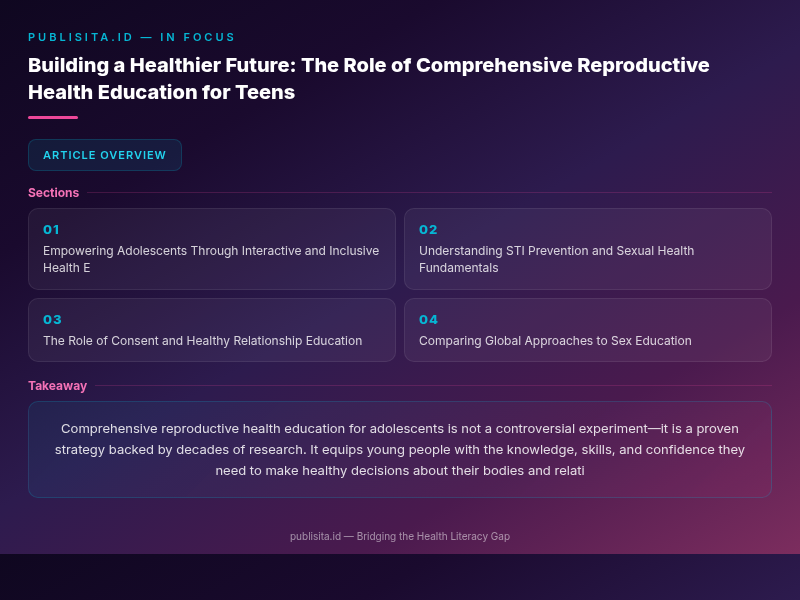
Infografik: Ringkasan visual artikel. Sumber: publisita.id & penelitian terkait.
Empowering Adolescents Through Interactive and Inclusive Health Education

Comprehensive reproductive health education plays a vital role in equipping adolescents with essential knowledge and skills for navigating their sexual and reproductive health. This approach transcends mere anatomical lessons by encompassing a broad range of topics such as consent, contraceptive methods, sexually transmitted infections (STIs), and the spectrum of gender identity and sexual diversity. By offering medically accurate and age-appropriate content, comprehensive education empowers young individuals to make informed decisions responsibly, setting a foundation for healthy life choices.
Interactive and participatory learning methods are at the core of effective educational strategies in this domain. Techniques such as classroom discussions, role-playing, and scenario-based activities are employed to enhance critical thinking, communication, and decision-making skills among students. Curricula are crafted with cultural sensitivity and inclusivity, addressing diverse students’ needs, including those from marginalized backgrounds. This comprehensive perspective allows all adolescents to develop a profound understanding of bodily autonomy and self-esteem, crucial for their health and well-being.
Studies show that comprehensive reproductive education is more effective than abstinence-only approaches, especially in delaying sexual initiation, enhancing the use of contraception, and reducing STIs and unintended pregnancies (source). Programs that discuss gender and power dynamics explicitly are particularly successful, as they enable adolescents to identify and challenge societal norms that perpetuate inequality.
Implementation is critical to success, requiring concerted efforts from policymakers, educators, and healthcare providers to ensure access to quality reproductive health education. This collaborative approach is essential for improving health outcomes and fostering broader societal change through respect, empathy, and open dialogue.
Understanding STI Prevention and Sexual Health Fundamentals
An essential component of comprehensive reproductive health education is teaching adolescents about sexually transmitted infections (STIs) and how to prevent them. According to the World Health Organization, more than 1 million curable STIs are acquired every day worldwide, with young people aged 15-24 accounting for a significant proportion of these cases. Education on STI prevention should include accurate information about transmission routes, symptoms, treatment options, and the importance of regular testing. It is crucial to emphasize that many STIs can be asymptomatic, meaning individuals may unknowingly transmit infections to partners.
Comprehensive education also covers the full range of contraceptive methods available, including barrier methods (condoms), hormonal contraceptives (pills, patches, IUDs), and emergency contraception. Students should understand how each method works, its effectiveness rate, and its role in preventing both pregnancy and STIs. Importantly, education must address common misconceptions. such as the myth that withdrawal or douching prevents pregnancy. with evidence-based facts. Discussing contraception without shame or judgment is critical to ensuring adolescents can access and use these methods correctly when they become sexually active.
The Role of Consent and Healthy Relationship Education
One of the most transformative aspects of modern reproductive health education is its emphasis on consent, boundaries, and healthy relationships. Consent education goes beyond the simple “no means no” framework to teach “yes means yes”. affirmative, enthusiastic, and ongoing consent. Students learn that consent must be freely given, reversible, informed, enthusiastic, and specific (the FRIES model). This framework helps young people understand that consent is not a one-time checkbox but an ongoing conversation in any intimate interaction.
Healthy relationship education teaches adolescents to identify the characteristics of respectful relationships versus unhealthy or abusive dynamics. Warning signs such as jealousy, possessiveness, pressure to do things they are not comfortable with, and attempts to isolate them from friends and family are discussed openly. By empowering teens with this knowledge, comprehensive reproductive health education reduces the likelihood of dating violence, coercion, and exploitation. For more on this topic, read our article on sexting awareness and digital safety for teens.
Comparing Global Approaches to Sex Education
The effectiveness of reproductive health education varies significantly across different regions and educational systems. Countries like the Netherlands, which implement comprehensive sex education from an early age, consistently report some of the lowest rates of teenage pregnancy and STIs in the world. Research from the Guttmacher Institute highlights that Dutch teenagers are more likely to use contraception consistently and have their first sexual experience later than teens in countries with abstinence-only education.
In contrast, regions that emphasize abstinence-only approaches often see higher rates of teen pregnancy and STIs, as young people lack the knowledge to protect themselves when they do become sexually active. Evidence from multiple studies published in the Journal of Adolescent Health confirms that comprehensive sex education does not increase sexual activity. rather, it leads to healthier outcomes for those who are already sexually active and encourages delayed initiation among those who are not. Indonesia’s national curriculum has increasingly incorporated reproductive health topics, but implementation varies widely between urban and rural schools, highlighting the ongoing need for standardized, evidence-based approaches.
The Role of Parents in Reproductive Health Education
Parents play an irreplaceable role in their children’s reproductive health education, even when formal school programs exist. Research consistently shows that adolescents who have open, ongoing conversations with their parents about sexuality are more likely to delay sexual initiation and use contraception when they become sexually active. Unfortunately, many parents feel ill-equipped to have these conversations, often due to their own discomfort or lack of accurate information. The key is to start early, keep conversations age-appropriate, and position yourself as a reliable source of information rather than a judgmental authority. Simple strategies like asking open-ended questions, watching educational content together, and sharing your family values about relationships can build a foundation of trust that lasts through the teenage years and beyond.
Conclusion: A Call to Action for Parents and Educators
Comprehensive reproductive health education for adolescents is not a controversial experiment. it is a proven strategy backed by decades of research. It equips young people with the knowledge, skills, and confidence they need to make healthy decisions about their bodies and relationships. For parents who may feel uncomfortable discussing these topics at home, remember that your children are already receiving information from peers, the internet, and social media. The question is not whether they will learn about sex and reproduction, but whether the information they receive will be accurate, age-appropriate, and aligned with your values. Open an honest dialogue with your teen today. it is one of the most important conversations you will ever have.
